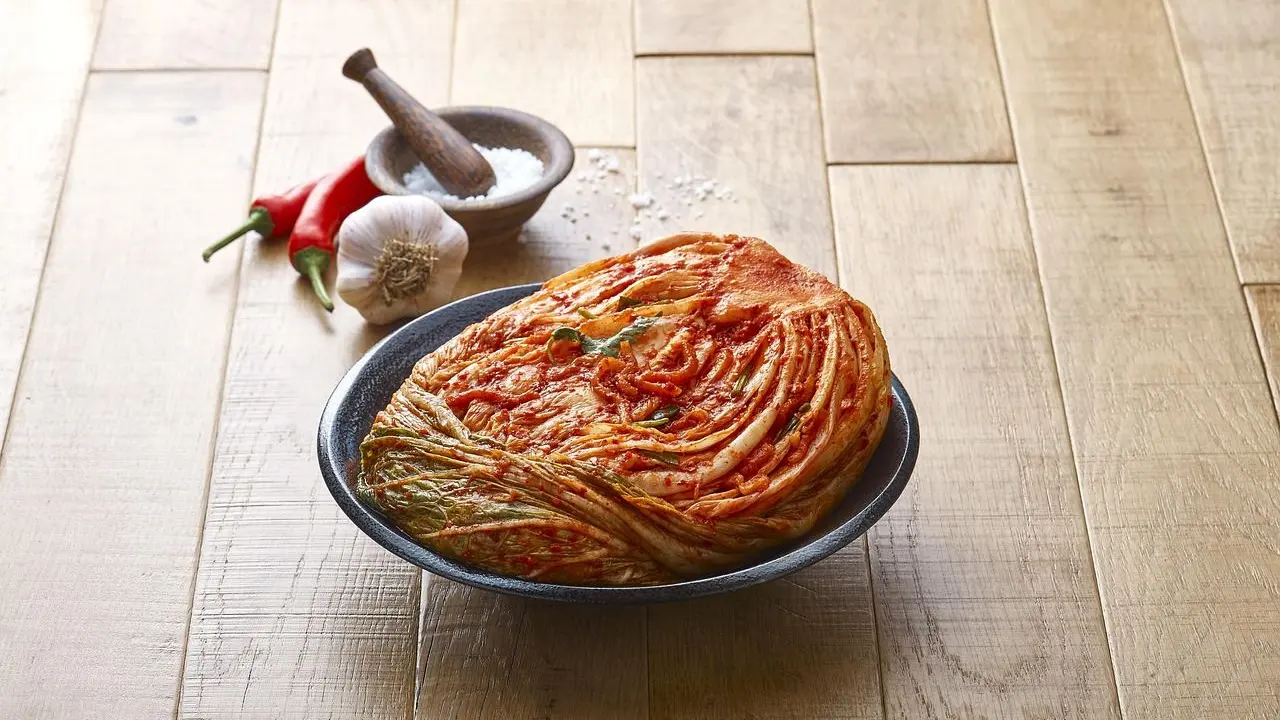
Wondering how to make kimchi without a fermentation background? Salt napa cabbage, coat it in a chili-rice paste, and let it ferment at cool room temperature for a few days before chilling it. You can do it with basic kitchen tools.
This page is part of the korean food guide, which collects Korean recipes and cooking basics in one place.
| Item | Value |
|---|---|
| Salting whole cabbage quarters | about 6 to 8 hours |
| Salting cut cabbage pieces | about 2 hours |
| Room-temperature fermentation | 2 to 5 days at 65 to 70°F |
| Fridge time for flavor to develop | about two weeks |
| Fridge storage | up to three months |
These figures come from Korean Bapsang and America’s Test Kitchen. Recipes differ and times can change with your kitchen, so check the source before you rely on them.
What you need to make kimchi at home
Kimchi is not a single recipe. Alphafoodie explains that the word is an umbrella term for vegetable dishes that have been salted, seasoned and then fermented, which is why households and regions each have their own versions (Alphafoodie).
The version below is whole-leaf napa cabbage kimchi, often called pogi kimchi, a name that refers to using the intact cabbage head (Alphafoodie). It takes more patience than chopped kimchi, because you spread paste over every leaf, but the method is simple.
The small-batch recipe from Korean Bapsang uses these main ingredients:
- Napa cabbage: 1 large head, about 5 to 6 pounds
- Korean coarse sea salt: 1 cup, plus 5 cups of water for the brine
- Korean radish: 1 pound, cut into matchsticks
- Gochugaru (Korean chili flakes): 1/2 cup, adjusted to taste
- Salted fermented shrimp (saeujeot): 1/4 cup
- Fish sauce: 3 tablespoons
- Garlic and ginger: 3 tablespoons of minced garlic and 1 teaspoon of grated ginger
- Glutinous rice flour: 1 tablespoon, for the rice paste
- Scallions: cut diagonally into short pieces
The chili matters most. Alphafoodie says gochugaru is critical to the authentic kimchi flavor, and that another type of chili will change the taste (Alphafoodie). Buy it at a Korean market or online if your supermarket does not stock it.
Beyond Kimchee advises wearing clean, food-safe kitchen gloves when you apply the seasoning paste, to protect your hands from the chili and garlic (Beyond Kimchee). Add a large bowl, a colander and an airtight jar or container to the list.
Salting the cabbage
Start by quartering the cabbage without slicing all the way through. Korean Bapsang says to cut the thick white part in half lengthwise and pull the halves apart by hand, because running the knife through would cut off leaves (Korean Bapsang). Repeat on each half to make quarters.
- Dissolve 1/2 cup of the salt in 5 cups of water, then bathe each quarter in it and shake off the excess (Korean Bapsang).
- Sprinkle the remaining salt generously over the thick white part of each leaf, then pour the leftover salt water over the cabbage.
- Set it aside for about 6 to 8 hours, moving the bottom quarters to the top every 2 to 3 hours (Korean Bapsang).
- Rinse thoroughly 3 times, especially between the white parts, and drain cut side down (Korean Bapsang).
Judge readiness by feel rather than the clock. The cabbage is ready to wash when the white parts of the leaves are bendable, and a bit of resistance is fine (Korean Bapsang).
If you cut the cabbage into bite-size pieces first, salting is much faster. America’s Test Kitchen lets cut pieces sit for about 2 hours, tossing every 30 minutes, until they are shrunken and softened (America’s Test Kitchen).
The salt does two jobs. It draws excess moisture out of the cabbage and also kills off spoilage microbes, according to the same source (America’s Test Kitchen).
Making the paste and filling the leaves
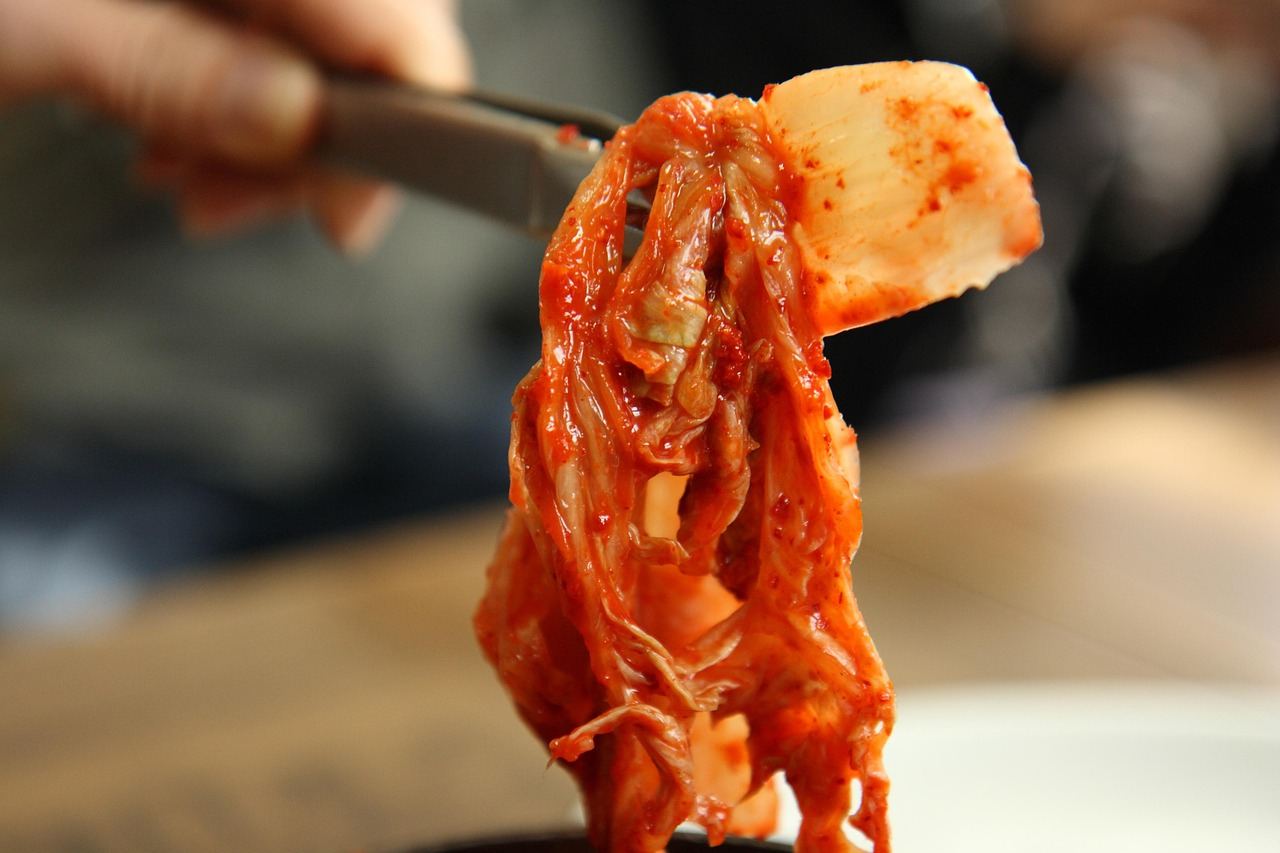
While the cabbage salts, cook the rice paste. Alphafoodie explains that this porridge allows all the spices to stick to the cabbage, and that it must cool down completely before you use it (Alphafoodie).
Once the cabbage is rinsed and draining, work through these steps:
- Cook the glutinous rice flour with water over low heat, stirring now and then, until it forms a thin paste. Let it cool.
- Combine the garlic, ginger, salted shrimp, fish sauce, gochugaru and the cooled rice paste with a little water. Set it aside until the gochugaru dissolves slightly and becomes pasty.
- Cut the radish into matchsticks and the scallions into short diagonal pieces. Mix the seasoning into the radish by hand (with gloves), then fold in the scallions.
- Taste a little. Korean Bapsang says it should be a little too salty to eat as is, and you can add salt, more shrimp or fish sauce if needed (Korean Bapsang).
- Trim the tough stem from each cabbage quarter, leaving enough to hold the leaves together. Spread the radish mixture over each leaf.
- Fold the leafy part toward the stem and wrap the bundle with the outermost leaf. Place it cut side up in your jar.
Press down hard once everything is in the container to remove air pockets. Then rinse the mixing bowl with a little water and pour it over the kimchi so none of the seasoning is wasted.
Fermenting and storing kimchi
Fermentation is where the flavor develops, and recipes give different windows. Treat them as a range and let your nose and tongue decide:
- Korean Bapsang: leave the jar out at room temperature for a full day or two, longer if the weather is cool, then move it to the fridge (Korean Bapsang).
- America’s Test Kitchen: ferment for 2 to 5 days in a 65 to 70°F spot away from direct sunlight, and taste daily after 2 days (America’s Test Kitchen).
- Beyond Kimchee: keep it around 68°F (20°C) for approximately 1-2 days, checking progress daily (Beyond Kimchee).
Leave room in the container. America’s Test Kitchen recommends 2 inches of headspace and a plastic-wrap layer pressed on the surface of the cabbage, and says to keep a glass lid slightly loose to prevent gas buildup (America’s Test Kitchen).
What you are tasting is lactic acid. The salt-tolerant bacteria consume sugars and produce lactic acid, which lowers the pH and makes the kimchi inhospitable to harmful bacteria and mold while adding tang (America’s Test Kitchen).
Beyond Kimchee goes one step further and suggests using a food-safe pH strip or meter to confirm the kimchi has reached pH 4.6 or below before eating (Beyond Kimchee). If you are unsure, that check is a sensible extra.
After fermenting, refrigerate the kimchi. Korean Bapsang says it needs about two weeks in the fridge to fully develop its flavors (Korean Bapsang), while America’s Test Kitchen says it can be refrigerated for up to three months, after which it turns deeply sour and is more typically called shin kimchi (America’s Test Kitchen).
Adjusting kimchi to your table
Heat is easy to tune. Alphafoodie notes that you can tweak the spiciness to your liking, which helps if you are cooking for people who are not used to very spicy food (Alphafoodie). Start with less gochugaru and add more next time.
Traditional kimchi usually contains seafood. Beyond Kimchee points out that its recipe has seafood in both the stock and the seasoning, and it offers a separate vegan version for people who want an alternative (Beyond Kimchee). If you avoid fish, the vegetarian korean food page is a good place to look for meat-free Korean dishes.
Kimchi is a workhorse in Korean cooking. America’s Test Kitchen lists dishes built on it, such as kimchi jjigae (kimchi stew), kimchi bokkeumbap (kimchi fried rice) and kimchi jeon (kimchi pancakes), and suggests serving it with rice, noodles or eggs (America’s Test Kitchen). For a full meal, pair a spoonful with the bibimbap recipe.
Frequently asked questions
How long before I can eat homemade kimchi?
Show answer
Korean Bapsang says you can start eating it any time, but it needs about two weeks in the fridge to fully develop its flavors (Korean Bapsang).
Can I use a different chili instead of gochugaru?
Show answer
It is technically possible, but Alphafoodie warns the taste will definitely change (Alphafoodie). For the classic flavor, stick with Korean chili flakes.
Do I need glutinous rice flour?
Show answer
America’s Test Kitchen says sweet white rice flour can be replaced with all-purpose flour (America’s Test Kitchen). The paste still needs to be cooked and cooled before you use it.
How can I tell my kimchi has fermented enough?
Show answer
Taste it. America’s Test Kitchen suggests tasting daily after 2 days until it reaches your desired tanginess, effervescence and fermented flavor (America’s Test Kitchen). For a safety check, Beyond Kimchee recommends a pH strip or meter reading of 4.6 or below (Beyond Kimchee).