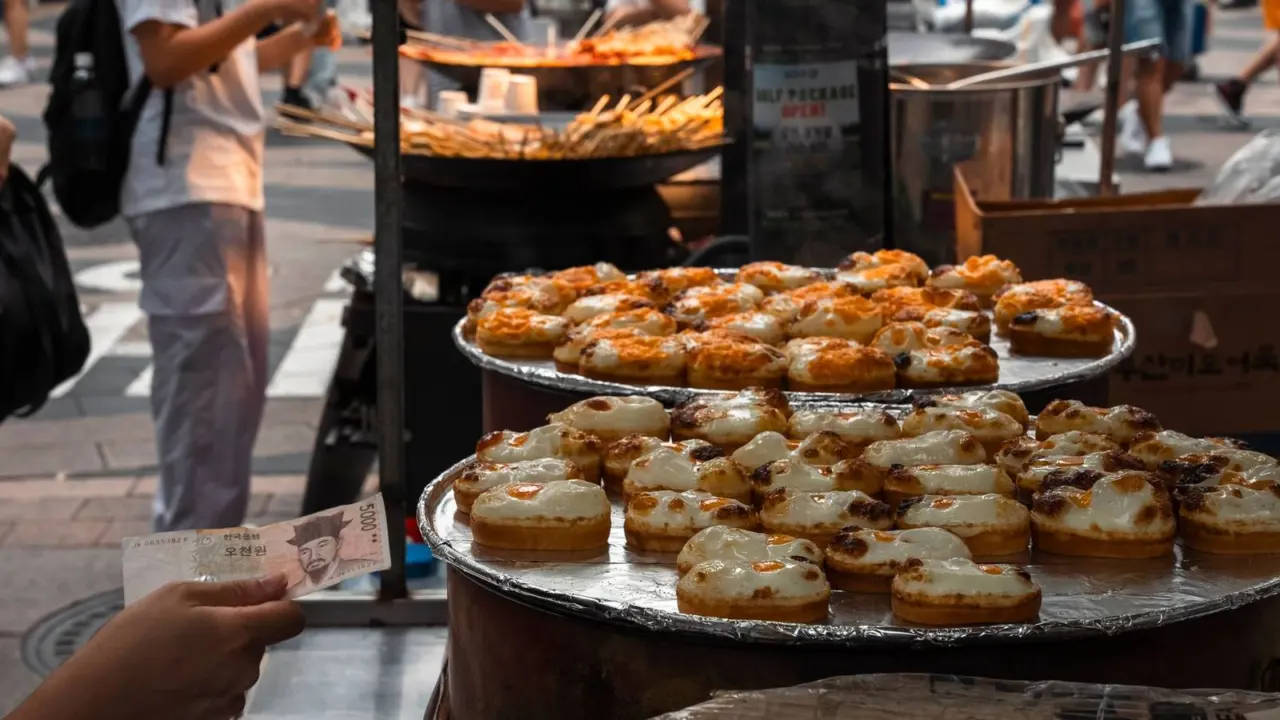
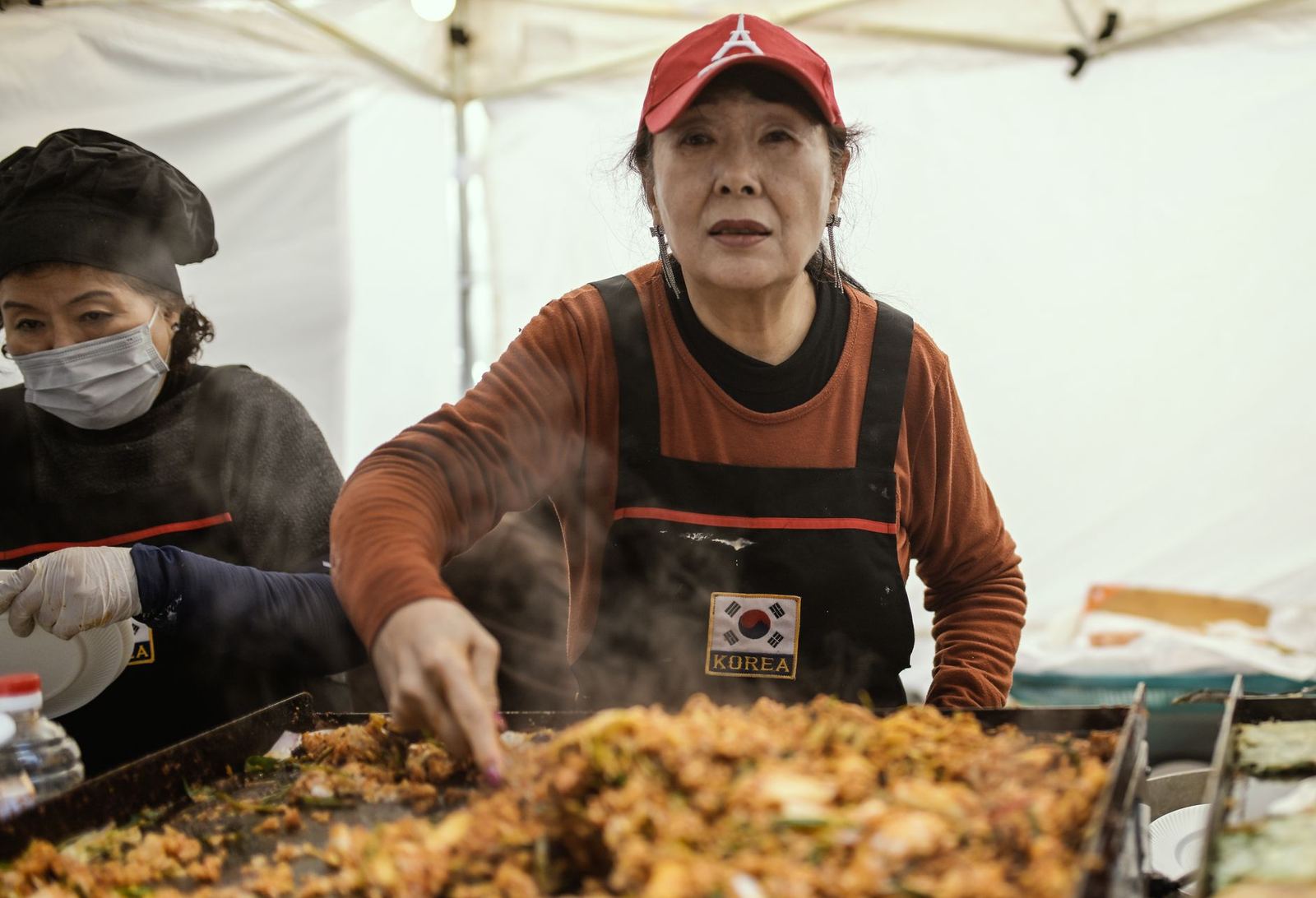
Standing at a Seoul market with no idea what to order? Korean street food is easiest to start with bungeoppang, hotteok and fish cake skewers: warm, cheap snacks sold from carts, tents and stalls.
For the wider picture of dishes and home cooking, browse the korean food guide.
| Item | Value |
|---|---|
| Bungeoppang at some downtown Seoul street stalls | 1,000 won apiece |
| Red bean or custard bungeoppang at Chonggakne Bungeoppang | 1,500 won each |
| Bboong Ice Cream (bungeoppang used as a cone) | 4,000 won |
| Salted-butter bungeoppang at the CHILDISH cafe | 4,500 won apiece |
| Stalls in Myeong-dong | 200 stalls, half of them food stalls |
The prices come from The Korea Times winter street food guide of December 2024, and the stall count from Wikipedia’s page on street food in South Korea. Figures can change, so check the source before you rely on them.
Why Korean street food suits first-time visitors
Street food has long been part of everyday life in South Korea. Wikipedia’s overview says it historically included eomuk, bungeo-ppang and tteok-bokki, and that it has seen a popular resurgence in recent years.
Season shapes what you will find. The same page says traditional street foods are most common in winter, while ice cream is more popular in summer.
Speed is part of the appeal, because the page says food ordered is served within 2-3 minutes. It also notes that the preparation can be entertainment in itself, such as watching a vendor work on an iron plate.
Myeong-dong is the best-known stop for a first taste: the same Wikipedia page counts 200 stalls there, half of them food stalls. Other areas worth a detour include:
- Hongdae: a large variety of snacks, from tteokbokki and dakgangjeong to churros, crepes and takoyaki.
- Namdaemun Market: hotteok lines, bungeoppang and roasted sweet potatoes in the alleys.
- Gwangjang Market: a covered market suited to a sit-down street-food meal.
Sweet winter snacks to try first
A January 2022 piece in the culture ministry’s Korea Here & Now series described dozens of people lined up around the block in Namdaemun Market for hotteok, a flat, grilled pastry filled with brown sugar, honey and cinnamon. You can read it in the Ministry of Culture, Sports and Tourism’s winter street food report. Cold weather clearly does not slow street food down.
That same report lists a handful of warm treats you can find in the alleys:
- Hotteok: sweet, filled pancakes cooked on a griddle.
- Bungeo-bbang: a carp-shaped bread stuffed with red bean paste, made in a hot cast-iron mold.
- Walnut cakes and steamed corn: simple snacks to eat while walking.
- Roasted sweet potatoes: a classic way to warm your hands.
Dalgona is the playful one. The report says vendors gained new popularity after a hit TV series featured the candy, which is made of melted sugar and baking soda. Customers try to free an intact shape from the brittle surface, and sellers usually reward success with a free dalgona.
Bungeoppang: history, fillings and price
Accounts of where bungeoppang comes from differ. A December 2024 culture ministry article traces it to the early 1930s, when bakers made chrysanthemum-shaped snacks from flour paste batter, while The Korea Times says the Japanese taiyaki was introduced to Korea during the 1910-45 Japanese occupation.
Both accounts agree on its rise as a working-class snack. The culture ministry article says popularity emerged after the Korean War, alongside flour aid, and that during the 1960s and 1970s factory workers relied on it as quick, affordable food.
Fillings have become a friendly argument. The same article describes a classic rivalry between “patbung-pa” (fans of red bean paste filling) and “chouxbung-pa” (fans of custard cream filling), and notes newer varieties with cheese, pizza and kimchi.
What it costs
Prices in The Korea Times guide varied widely as of its December 2024 publication. Some downtown Seoul vendors charged 1,000 won apiece, while Chonggakne Bungeoppang priced red bean and custard cream at 1,500 won and other fillings at 2,000 won.
At Namyeongyeok Ingeoppang, the guide reported three for 2,000 won, with purchases limited to six per person. Its ingeoppang is a chewier variation made with glutinous rice flour.
Cafes charge more, according to the same guide:
- CHILDISH: a salted-butter bungeoppang at 4,500 won apiece.
- Bboongeo Dang: regular-sized bungeoppang from 1,500 won to 2,500 won, depending on the filling.
- Bboongeo Dang’s Bboong Ice Cream: 4,000 won.
The guide links the shift to rising costs of ingredients and labor, which it says have also thinned out street vendors. Korean map providers and the marketplace Karrot have launched a bungeoppang map to help you find those that remain.
Savory bites and night-time pojangmacha
When the markets close, the evening crowd moves on. The culture ministry’s January 2022 report, linked here, says the area around Jongno and Dongdaemun Market fills with pojangmacha, cart restaurants under large tents and canopies, serving fried seafood, pig trotters and buchimgae (pan-fried fritters).
The word literally means “covered wagon” in Korean, according to Wikipedia. That page adds that many of these spots serve alcohol such as soju in the evening.
For a proper sit-down meal, the same culture ministry report points to Gwangjang Market near Jongno 5-ga Station. The open-air market sits under a permanent canopy and is known for bindaetteok (mung bean pancake) and mayak gimbap, so named because one of these mini rolls can get you hooked.
Newer ideas keep appearing, too:
- Potato twists: a whole potato sliced into a spiral over a half-meter-long skewer, seen in Myeong-dong.
- Croffles: a croissant-waffle combination sold from carts.
- Halal street food: the report profiles a stall serving kebabs and falafel since 2008.
Practical tips before you queue
Hours and lines matter more than you might expect. As reported in December 2024 by The Korea Times, Chonggakne Bungeoppang kept limited hours from noon to 5 p.m., except Mondays and Fridays, and Namyeongyeok Ingeoppang ran from 7 a.m. to 7 p.m., except Sundays. Both advised arriving early, since popular stalls often sell out.
- Go early for famous stalls, and treat posted hours as a guide that can change.
- Look up a bungeoppang map on Karrot to find the nearest vendor, since these crowdsourced maps are built by locals.
- Bring an appetite for sharing, so you can taste more than one snack in a market.
- Expect variety in standards: Wikipedia notes concerns about hygiene and says the number of pojangmacha in Seoul has declined, partly because many vendors operate without permits.
When the cravings follow you home, this kimchi jjigae recipe is a warming next step, and a gochujang substitute can save a spicy dish when your pantry runs short.
Frequently asked questions
When is the best season for Korean street food?
Show answer
Winter is the classic season for hot snacks such as bungeoppang and hotteok. Summer visitors should expect cold treats to take the lead, as the Wikipedia overview points out.
How much does bungeoppang cost?
Show answer
It depends on where you buy it. The Korea Times reported 1,000 won apiece at some downtown Seoul stalls and 4,500 won at a trendy cafe as of December 2024.
What is a pojangmacha?
Show answer
It is a small tented spot, sometimes on wheels, that sells snacks and, in the evening, drinks. Wikipedia says the word literally means “covered wagon”.
Is Gwangjang Market good for a sit-down meal?
Show answer
The culture ministry’s January 2022 report calls it a popular destination for a proper sit-down street-food meal, famous for bindaetteok and mayak gimbap.
Are there halal street food options?
Show answer
The same January 2022 report describes a stall serving kebabs, falafel and other halal street food since 2008. Check with any vendor directly about ingredients.